

By The Recomp Lab
Wed Oct 08 2025
How to Lose Fat and Build Muscle at the Same Time (Body Recomposition 101)
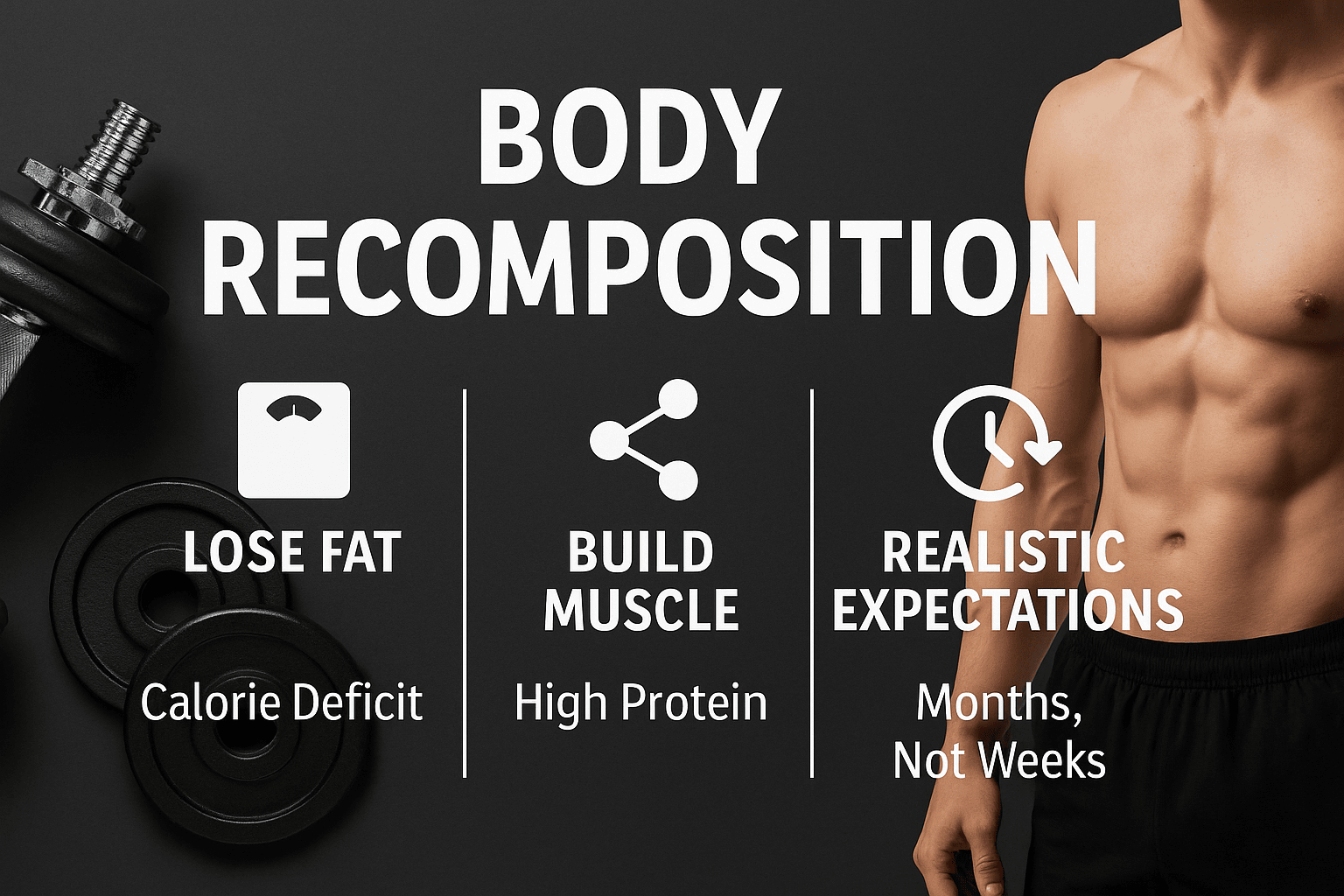
Most people think you have to bulk to gain muscle or cut to lose fat. But what if you could do both at the same time? That’s the goal of body recomposition: reducing fat while adding lean muscle mass.
It’s not magic — it’s science. With the right nutrition, training, and recovery strategy, recomposition is possible for many people. Let’s break it down.
What Is Body Recomposition?
Body recomposition is the process of changing your body’s ratio of muscle to fat. Instead of focusing only on the scale, you focus on:
- Losing fat mass
- Building muscle mass
The end result? You might weigh the same (or even more), but you look leaner, stronger, and more athletic.
Nutrition: Balancing Calories & Macros
Step 1: Calorie Balance
To lose fat, you need a calorie deficit.
To build muscle, you need a calorie surplus.
Recomposition happens when you strike the middle ground:
- Eat at maintenance calories (enough to fuel growth without excess fat).
- Adjust based on progress — slight deficit on rest days, slight surplus on training days.
Step 2: Protein is King
Protein is the cornerstone of recomposition. Aim for:
- 1.6–2.2g of protein per kilogram of bodyweight daily.
This ensures your body has the building blocks to repair and grow muscle.
Step 3: Carbs & Fats Matter Too
- Carbs fuel your workouts and replenish glycogen.
- Healthy fats support hormones critical for muscle growth and fat loss.
Balanced macro split example:
- 40% Protein
- 35% Carbs
- 25% Fats
Training: Intensity & Volume Are Key
To achieve body recomposition, your workouts need to stimulate muscle growth and burn calories.
- Progressive Overload: Gradually increase weight, reps, or sets over time.
- Train Close to Failure: Leave 1–2 reps in the tank.
- Frequency: Aim to train each muscle group 2–3 times per week.
- Blend Resistance & Conditioning: Strength training builds muscle, while short bursts of conditioning (like HIIT) help accelerate fat loss.
Your body doesn’t just change from working out — it changes from working out with purpose.
Recovery & Consistency
Muscle doesn’t grow in the gym — it grows when you rest.
- Sleep 7–9 hours per night
- Manage stress
- Take rest days seriously
Consistency matters more than perfection. Small improvements compound over weeks and months.
How AI Coaching Makes Recomposition Smarter
Balancing fat loss and muscle growth is tricky. Too much deficit? You lose muscle. Too much surplus? You gain fat.
This is where an AI-powered fitness app can help:
- Calculates your personal calorie and macro targets
- Builds a training split that balances volume, intensity, and recovery
- Adjusts your plan dynamically based on progress (strength gains, weight changes, recovery markers)
- Tracks your data so you know if you’re moving toward recomposition — not just “guessing”
Instead of wondering if you’re eating or training right, AI coaching gives you feedback and adjustments in real time.
Realistic Expectations
Body recomposition is possible, but:
- Progress is slower than a bulk or cut
- Beginners, detrained athletes, and people with higher body fat see the fastest results
- Advanced lifters may need to alternate between phases for best results
Think months, not weeks. The changes are subtle at first but powerful over time.
Takeaway
Body recomposition comes down to:
- Eating enough protein
- Training hard with progressive overload
- Managing calories smartly
- Recovering consistently
It’s not about crash diets or endless cardio — it’s about creating the right environment for muscle growth and fat loss to happen together.
Join our newsletter!
Enter your email to receive our latest newsletter.
Don't worry, we don't spam
Popular Articles
Related Articles
 Tue Oct 07 2025
The Bulk Phase Explained: How to Maximize Muscle Growth Without Gaining Excess Fat
Learn how to bulk the smart way. Discover calories, macros, training, and how AI coaching optimizes your bulk for maximum muscle growth.
 Tue Oct 07 2025
The Cut Phase Explained: How to Lose Fat While Keeping Muscle
Learn how to cut fat while keeping muscle. Discover calorie deficit strategies, macros, training, and how AI coaching guides your cut for lasting results.
 Sat Oct 11 2025
Training Smarter, Not Harder: Why AI Is the Future of Fitness Coaching
Discover how AI fitness coaching personalizes workouts, tracks progress, and adapts in real time — helping you train smarter, not harder.
 Thu Oct 09 2025
How to Build a Workout Split That Maximizes Muscle Growth
Learn the pros and cons of popular workout splits and discover the key rule for hypertrophy: train each muscle as often as recovery allows.
 Thu Oct 09 2025
The Science of Hypertrophy: How Muscle Growth Really Works
Learn how hypertrophy works, the science of muscle growth, and how to optimize training, nutrition, and recovery for maximum results.